755nm vs 808nm vs 940nm vs 1064nm: Which Diode Laser Wavelength Is Best?
Author:pz
+Table of Contents
Quick Answer
There is no single “best” diode laser wavelength for every hair removal treatment.
Generally, 755nm offers stronger melanin absorption,
808nm provides a versatile balance, while
940nm and 1064nm
offer deeper penetration.
For professional clinics, a multi-wavelength diode laser
can offer greater treatment flexibility than a single-wavelength system.
So the right choice depends on hair thickness, follicle depth, skin characteristics, treatment area, and treatment goals.
Why Does Diode Laser Wavelength Matter?
Diode Laser Wavelength is one of the most important technical factors in a diode laser hair removal system.
During laser hair removal, the laser energy is absorbed by chromophores in the treatment area, particularly melanin in the hair. The selected wavelength affects how the energy interacts with the skin and hair and how deeply it can penetrate into the tissue.
This is why different wavelengths can provide different treatment characteristics.
Wavelength and Melanin Absorption
Shorter and longer wavelengths interact differently with melanin.
A wavelength with stronger melanin absorption can be useful when targeting hair containing sufficient pigment. However, stronger absorption also means that treatment parameters and skin characteristics need to be carefully considered.
For professional users, wavelength should therefore never be evaluated in isolation.
Wavelength and Penetration Depth
Wavelength also influences how deeply laser energy can penetrate.
Generally, longer wavelengths can provide deeper penetration, while shorter wavelengths have stronger absorption characteristics in melanin.
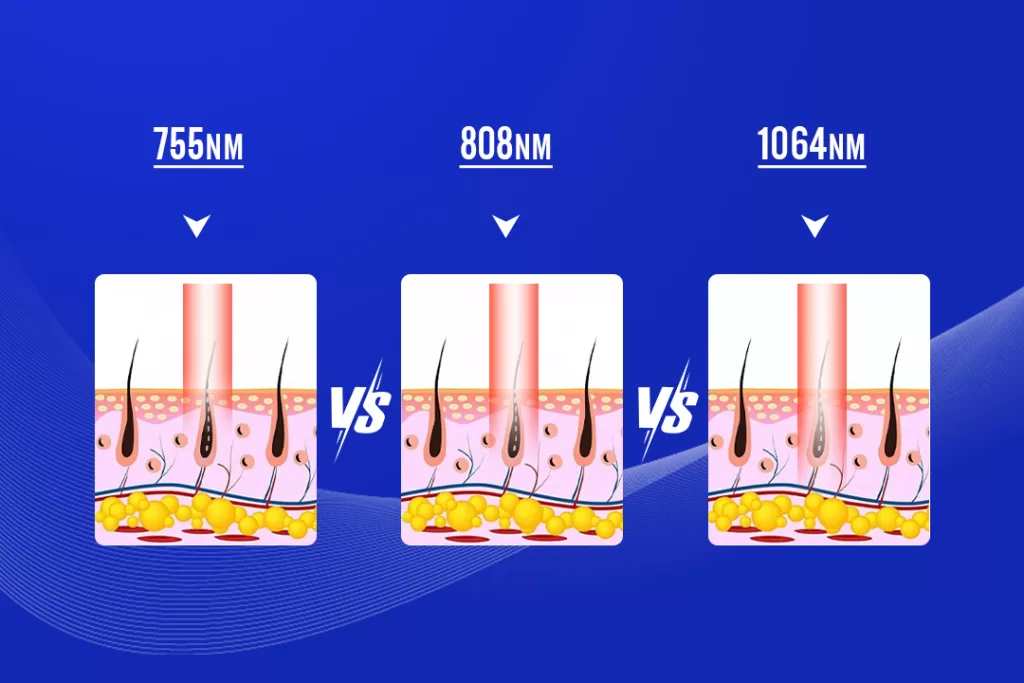
This creates different advantages across the 755nm, 808nm, 940nm, and 1064nm ranges.
Rather than asking which wavelength is universally better, clinics should ask:
Which wavelength is most appropriate for the hair, skin, treatment area, and treatment protocol?
755nm vs 808nm vs 940nm vs 1064nm
Wavelength
Key Characteristic
Typical Strength
Main Consideration
755nm
Higher melanin absorption
Fine or lighter hair considerations
More superficial targeting
808nm
Balanced performance
General hair removal
Versatile everyday option
940nm
Deeper penetration
Deeper follicles
Complementary wavelength
1064nm
Deeper penetration
Coarser or deeper hair
Lower melanin absorption
The key takeaway is simple:
Different wavelengths are designed to provide different treatment options, not to compete for a single “best” position.
For clinics treating a broad range of patients, combining wavelengths in one platform can therefore be more practical than relying on a single wavelength.
755nm Diode Laser: What Is It Best For?
The 755nm wavelength is known for its relatively strong interaction with melanin, making it an important wavelength in laser hair removal technology.
How Does 755nm Work?
Because 755nm has a relatively high affinity for melanin, it can be particularly useful when treating hair with suitable pigmentation.
The wavelength is often considered when working with finer or lighter hair characteristics where effective melanin targeting is important.
Typical Applications
A 755nm diode laser may be considered for:
Fine hair
Lighter or less dense hair
Facial hair
Areas requiring more precise treatment
Treatment protocols where stronger melanin absorption is desired
However, treatment parameters should always be adjusted according to the patient's skin characteristics, hair characteristics, and treatment area.
Is 755nm Better Than 808nm?
Not necessarily.
The 755nm and 808nm wavelengths serve somewhat different purposes. Instead of treating them as competing technologies, professional clinics can view them as complementary options.
This is one reason multi-wavelength systems can provide more flexibility than single-wavelength devices.
808nm Diode Laser: The Versatile Choice
808nm is one of the most widely recognized wavelengths in diode laser hair removal.
It is often considered a balanced wavelength because it provides a combination of melanin absorption and penetration suitable for a broad range of conventional hair removal applications.
Why Is 808nm So Widely Used?
The 808nm wavelength has become a common choice for professional hair removal because it can be applied across many treatment areas and hair characteristics.
It can be used for areas such as:
Arms
Legs
Back
Chest
Bikini area
Underarms
Other body areas
Its versatility makes 808nm particularly attractive to clinics looking for a straightforward, general-purpose diode laser configuration.
When Should a Clinic Choose 808nm?
For a clinic primarily focused on conventional hair removal and looking for a versatile wavelength, an 808nm configuration can be a practical choice.
However, clinics with a more diverse patient base may benefit from having additional wavelengths available.
940nm Diode Laser: Why Is This Wavelength Used?
940nm and Deeper Energy Delivery
Compared with shorter wavelengths, 940nm can provide deeper penetration characteristics.
This makes it a useful complementary wavelength when clinics want more flexibility in addressing different hair and follicle characteristics.
Where Can 940nm Add Value?
A 940nm wavelength can be considered when treating:
The main advantage of 940nm is therefore not that it replaces 755nm or 808nm, but that it adds another treatment option to a multi-wavelength platform.
Why Combine 940nm With Other Wavelengths?
A clinic rarely treats exactly the same type of hair on every patient.
Hair thickness, follicle depth, treatment area, and skin characteristics can vary significantly.
Having 940nm available alongside other wavelengths allows practitioners to build a more flexible treatment approach.
1064nm Diode Laser: When Is Deeper Penetration Important?
1064nm is a longer wavelength commonly associated with deeper penetration.
Compared with shorter wavelengths, 1064nm has lower melanin absorption, which can be advantageous in certain treatment scenarios when deeper energy delivery is desired.
How Is 1064nm Different?
The primary characteristic of 1064nm is its deeper penetration profile.
It can be particularly useful when considering:
Coarser hair
Deeper follicles
Certain body areas
Treatment protocols where deeper energy delivery is preferred
However, 1064nm should not simply be described as “better” than 755nm or 808nm.
It performs a different role. The key question is not:
Which wavelength is the strongest?
It is:
Which wavelength best matches the treatment requirement?
Which Diode Laser Wavelength Should You Choose?
When selecting a wavelength, professional clinics should consider at least four factors.
1. Hair Thickness
Fine and coarse hair may require different treatment strategies.
A multi-wavelength platform provides more options than a system limited to one wavelength.
2. Hair Depth
Follicle depth can vary between individuals and treatment areas.
Wavelength selection can therefore be considered together with the desired penetration characteristics.
3. Skin Characteristics
Skin pigmentation is an important consideration when selecting laser parameters.
The goal is not simply to select the strongest wavelength, but to find an appropriate balance between targeting the hair and managing the surrounding skin.
4. Treatment Area
Large body areas and small facial areas have very different workflow requirements.
This is why spot size and handpiece configuration are just as important as wavelength when choosing a professional diode laser.
Single-Wavelength vs Multi-Wavelength Diode Laser
For professional buyers, one of the most important questions is whether to choose a single-wavelength or multi-wavelength system.
Single-Wavelength Diode Laser
A single-wavelength system can be effective when a clinic has a clearly defined treatment strategy.
However, it offers less flexibility when the clinic treats patients with different hair characteristics, treatment areas, and clinical requirements.
Multi-Wavelength Diode Laser
A multi-wavelength system combines multiple wavelengths on a single platform.
Potential advantages include:
Greater treatment flexibility
More options for different hair characteristics
Adaptability across treatment areas
More customized treatment protocols
One platform instead of multiple single-wavelength machines
For a professional clinic, the value of multi-wavelength technology is therefore not simply having more wavelengths.
It offers more choices within a single treatment platform.
Why Choose a Configurable Diode Laser Platform?
For many clinics and distributors, flexibility is becoming just as important as raw laser power.
Instead of purchasing one fixed configuration, a configurable platform allows buyers to select the combination of:
Wavelengths
Laser power
Handpieces
Spot sizes
Cooling configuration
Treatment functions
This approach can be especially useful for distributors serving different markets because the ideal configuration may vary by region, target customer, and treatment positioning.
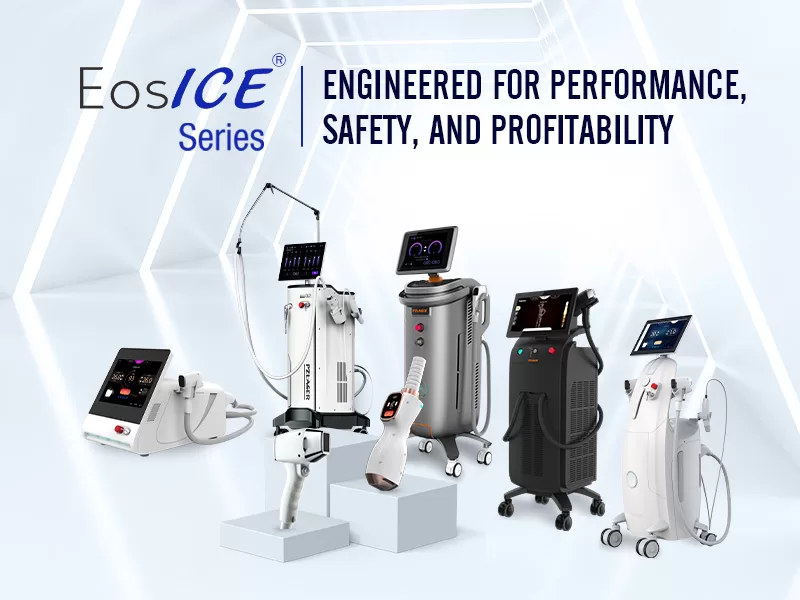
Rather than a single fixed machine, EOSICE® is a series of diode laser platforms that can be configured to meet different treatment and business requirements.
EOSICE® platform offers multiple wavelengths, including 755nm, 808nm, 940nm, and 1064nm, and different models and configurations can be equipped with different handpieces and treatment options.
This gives clinics and distributors more flexibility when selecting a system.
Depending on the selected EOSICE® configuration, buyers can choose different wavelength combinations.
For example:
808nm
755nm + 808nm + 1064nm
755nm + 808nm + 940nm + 1064nm
The advantage is that buyers do not have to choose a single fixed specification for every market.
They can select the configuration that best matches their treatment menu, target clients, and budget.
Flexible Handpiece and Spot Size Options
The latest PZLASER diode laser platform shown in the new product materials further expands this configurability.
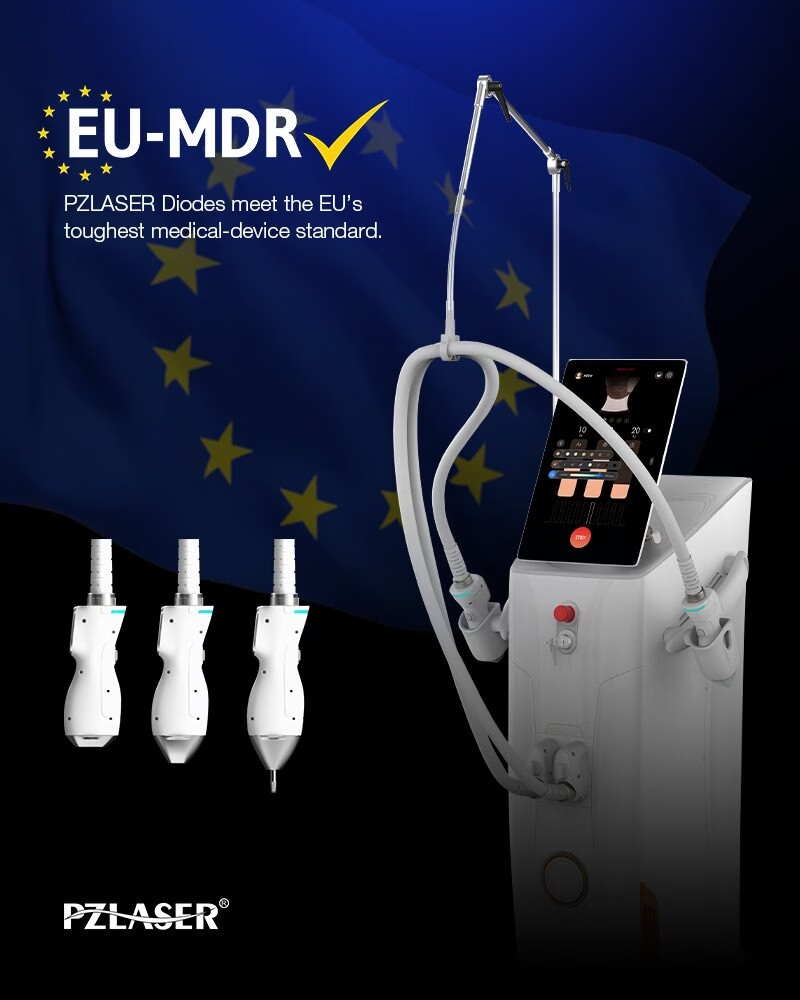
The MDR-certified three-wavelength configuration supports 755nm + 808nm + 1064nm and offers different treatment head configurations. The technical specifications list 6mm, 12×12mm, and 12×24mm spot sizes, with 1000W and 2000W treatment head options depending on the selected model.
The latest PZLASER platform introduces several design and workflow improvements.
Dual-Handle Operation
The upgraded system supports two handpieces working simultaneously, providing greater flexibility for professional treatment workflows.
For clinics with high treatment volumes, this can make it easier to prepare different treatment configurations or switch between operators and treatment areas.
New Crane Arm Design
The new crane-arm structure is designed to make handpiece positioning and operation more convenient.
This is particularly relevant during longer treatment sessions, where equipment ergonomics can influence operator comfort and workflow.
Front Plug-In Handpiece Design
The newly designed front plug-in handle provides an additional handpiece connection point and makes the system more convenient to operate.
Together, these upgrades focus on a simple objective:
More flexible equipment configuration without making daily operation more complicated.
Cooling: An Essential Part of a Professional Diode Laser
Wavelength is only one part of the equation.
A professional diode laser should also provide effective temperature management during treatment.
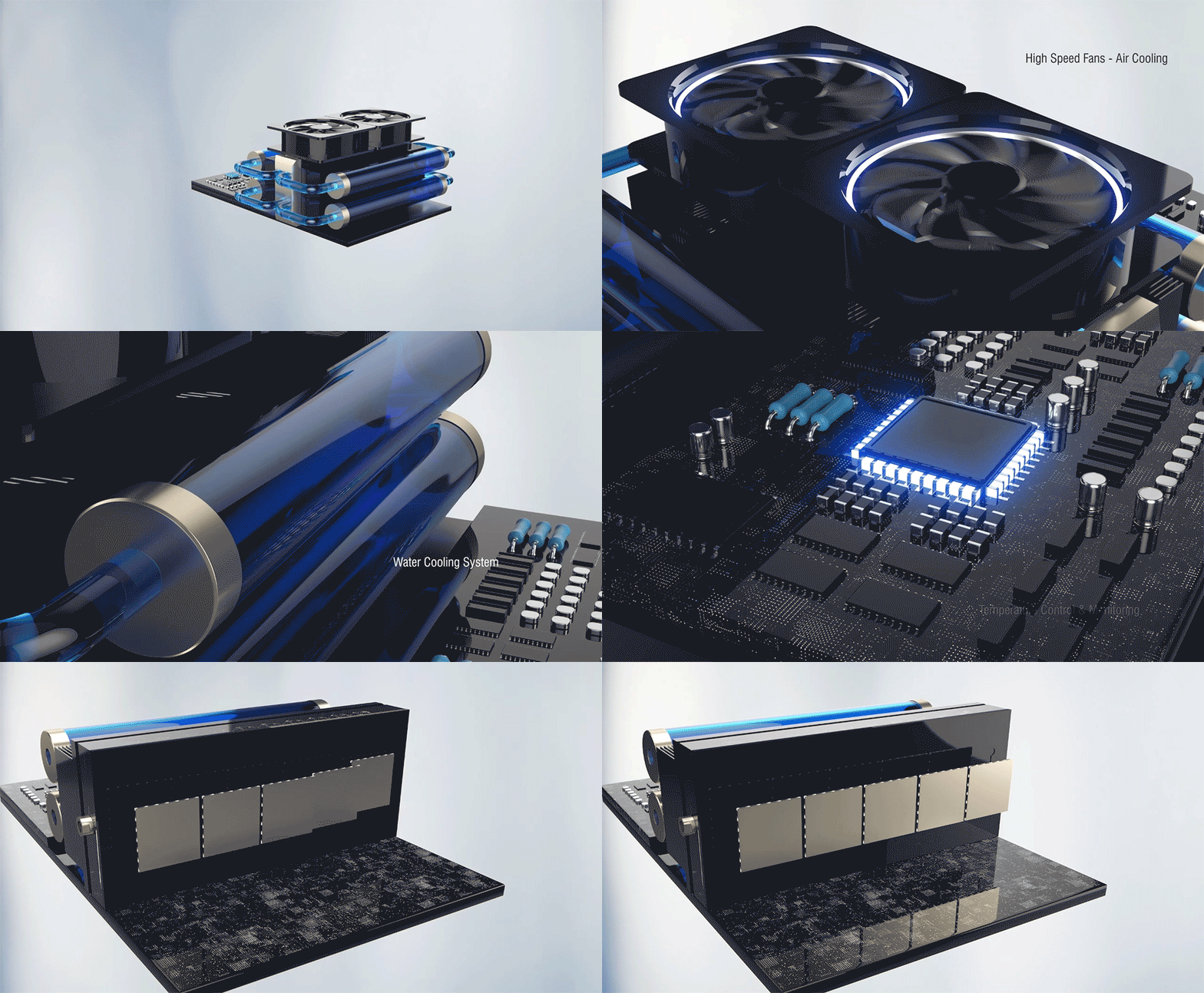
The EOSICE® platform combines TEC cooling, air cooling, water cooling, and heat-sink cooling, with temperature monitoring designed to support treatment comfort and system stability.
Cooling matters because it can help:
Improve patient comfort
Manage skin temperature
Support repeated treatment pulses
Improve the overall treatment experience
When comparing diode laser machines, buyers should therefore look at the complete system rather than focusing only on laser power.
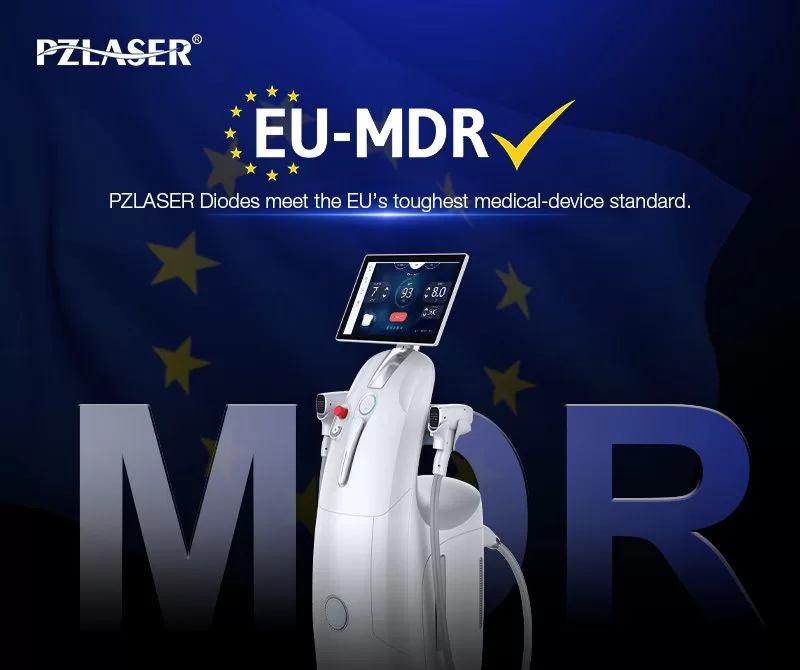
PZLASER officially achieved MDR certification for its Diode Laser Hair Removal system under EU Medical Device Regulation (EU) 2017/745. The company announced the certification in October 2025 as an important milestone in its international medical device strategy.
For buyers, MDR certification can be an important indicator when evaluating equipment for regulated markets.
It demonstrates that the certified device has gone through the applicable regulatory conformity process for the European medical device framework.
For distributors, this can provide additional confidence when evaluating a manufacturer for long-term cooperation and international market development.
755nm vs 808nm vs 940nm vs 1064nm: There is no universal “best” diode laser wavelength.
For professional buyers, the best diode laser is therefore not simply the machine with the highest power. It is the system that provides the right combination of:
For clinics and distributors looking for a configurable platform, the PZLASER EOSICE® series provides different wavelength and handpiece configurations, allowing the system to be matched to different treatment and business requirements.
Frequently Asked Questions About Diode Laser Wavelength
Is 808nm better than 755nm for laser hair removal?
Not necessarily. 755nm and 808nm have different absorption and penetration characteristics. The appropriate choice depends on hair characteristics, skin characteristics, treatment area, and treatment parameters.
Which diode laser wavelength is best for coarse hair?
Coarse hair may require different treatment strategies depending on follicle depth, hair pigmentation, skin characteristics, and treatment area. A longer wavelength such as 1064nm may be considered when deeper penetration is desired, but wavelength should always be evaluated together with the complete treatment protocol.
Is a 4-wavelength diode laser better than a single-wavelength laser?
A four-wavelength system can provide greater treatment flexibility because practitioners have more wavelength options. However, the ideal configuration depends on the clinic's patient base, treatment menu, target market, and budget.
What wavelengths are available in the EOSICE® series?
The EOSICE series supports different configurations, including 808nm, 755nm + 808nm + 1064nm, and 755nm + 808nm + 940nm + 1064nm. The available configuration depends on the specific model.